What to track after an anal fissure, and what to skip
A short, practical list of what is worth logging while you heal and after, why each item matters, and what you can safely leave out.
Key points
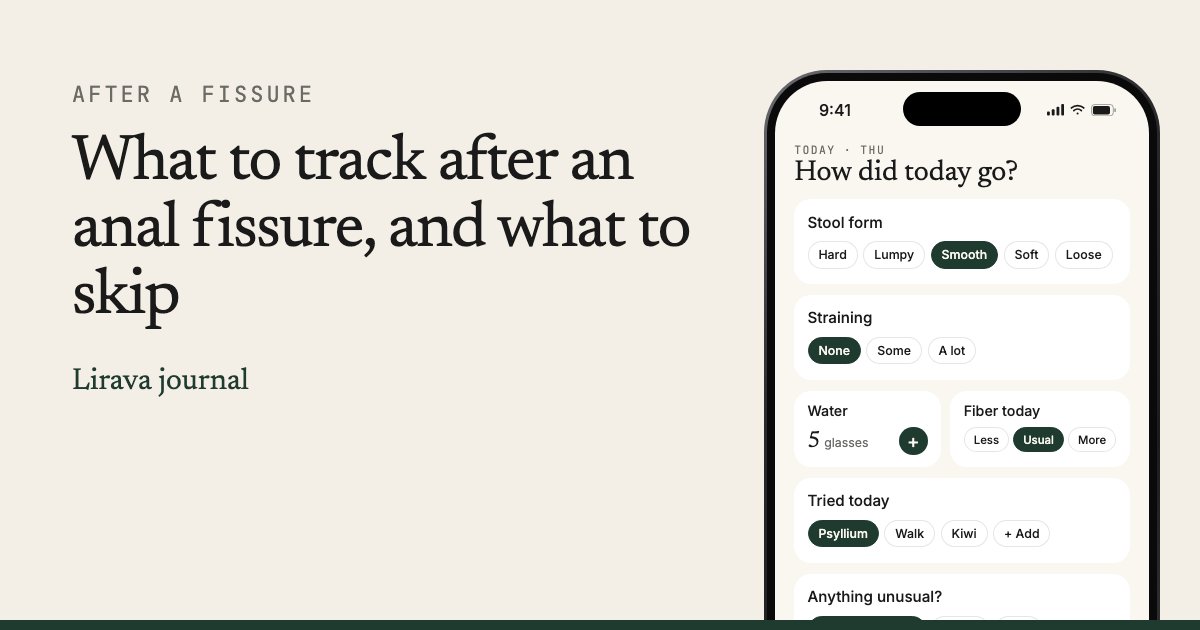
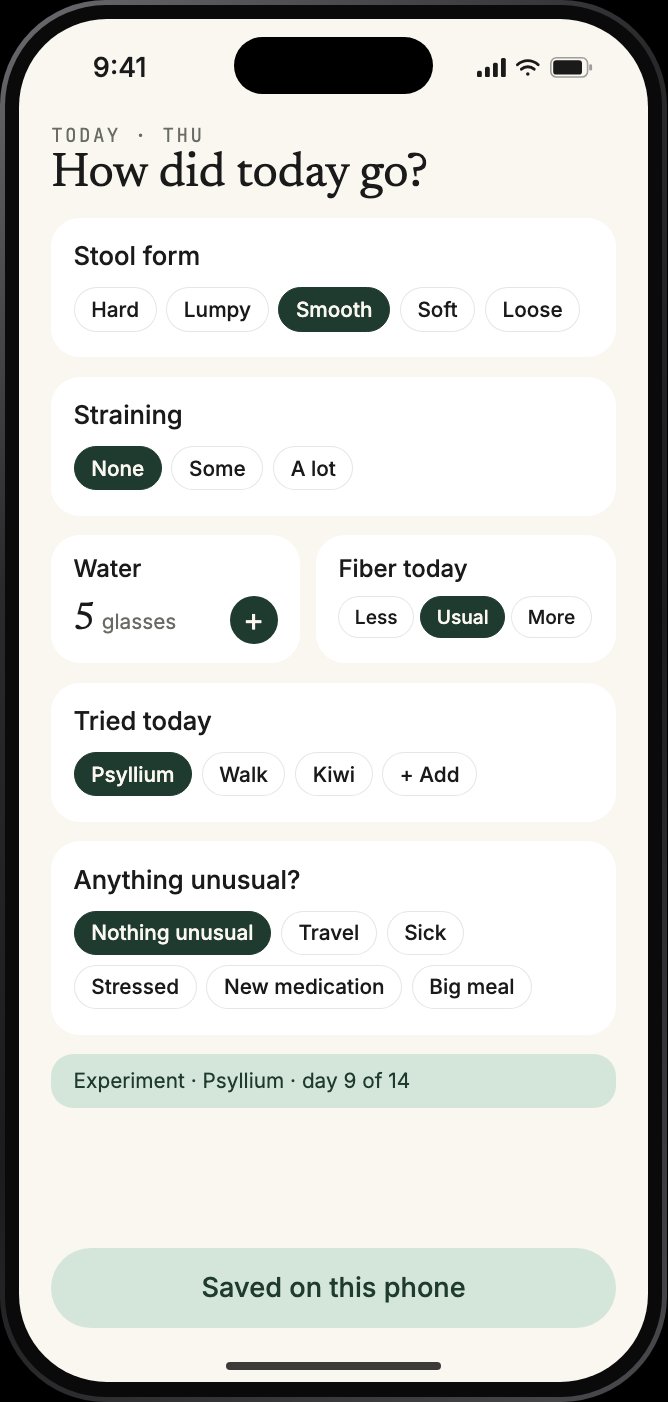
- Track a few things every day instead of many things sometimes: stool form, straining, water, fiber, and what you tried.
- While healing, add pain and bleeding. After healing, you can usually drop them and keep the rest light.
- Skip meal-by-meal food diaries. They are tedious, and most people stop within weeks.
- The months after healing are worth watching. In one trial, 68% of people on placebo had a recurrence within a year.
- Bleeding that does not stop, fever, severe or worsening pain, or unexplained weight loss means calling a doctor, not logging.
If you have had an anal fissure, you probably know the pattern people describe again and again: weeks of careful healing, then one hard day that sets everything back. A simple daily record will not heal anything on its own. What it does is replace guessing with your own evidence, so you and your clinician can see what actually lines up with easier days.
The trick is to track the few things that matter, every day, rather than everything, occasionally.
What is worth tracking
| What | How | Why it matters |
|---|---|---|
| Stool form | Pick the closest Bristol type, or simply hard, lumpy, smooth, soft, or loose | Hard stool is the thing most people are trying to avoid. Form tells you more than frequency. |
| Straining | None, some, or a lot | Straining is often the earliest sign that a routine is slipping. |
| Water | A rough count of glasses | Fiber is usually paired with fluids, so it helps to know if water changed too. |
| Fiber | Less, usual, or more than normal, plus any supplement | Enough to notice drift without weighing food. |
| What you tried | Tags such as psyllium, a walk, or a sitz bath | So you can compare days with and without it. |
| Anything unusual | Travel, illness, stress, a new medication, a big meal | These explain odd days, so they do not mislead you later. |
While you are still healing, add two more
- Pain during or after a bowel movement, on a 0 to 10 scale, and roughly how long it lasted.
- Bleeding: none, a trace on the paper, or more than that.
These are the details clinicians usually ask about, and they are hard to remember accurately a few weeks later. Once you are healed, most people can drop them and keep the rest of the log light.
What you can skip
- Meal-by-meal food diaries. They are the most common reason people quit tracking. A daily fiber rating catches most of what matters.
- Exact grams of fiber or milliliters of water, unless your clinician asks for them.
- Photos. They add stress and rarely add information a clinician can use.
- Checking the log several times a day. Tracking should lower your worry, not feed it. If it starts to feel compulsive, log less.
Why the months after healing matter
Clinical guidelines from the American Society of Colon and Rectal Surgeons describe fiber supplements such as psyllium and warm sitz baths as first-line care for acute fissures, and report that these measures alone resolve symptoms in roughly half of people. What happens after healing gets less attention.
One of the few trials to look at it followed 90 people whose fissures had recently healed. Over a year, recurrence was 68% on placebo, 60% on a low dose of bran, and 16% on 15 grams of bran a day. It is a single, older study of one kind of fiber, so it does not tell you what will work for you. It is a good reason to keep a light record after healing and to ask your clinician about a plan for that period.
When to stop logging and call someone
A log is for patterns, not emergencies. Contact a doctor promptly if you notice:
- bleeding from the rectum or blood in your stool, especially if it is new, heavy, or does not stop
- constant belly pain, vomiting, fever, or being unable to pass gas
- lower back pain or losing weight without trying
- pain that is severe, getting worse, or not improving after several weeks
Making it take 30 seconds
- Log once a day, at the same time, rather than after every bathroom trip.
- Use taps, not typing. Save free text for things you want to ask at your next appointment.
- Before an appointment, summarize the last few weeks on one page. Clinicians can do much more with a pattern than with the most recent bad day.
Common questions
Should I keep taking fiber after a fissure heals?
Some evidence points that way. In a 1987 trial of 90 people with recently healed fissures, those taking 15 g of bran a day had a 16% recurrence rate over a year, compared with 68% on placebo. It was one small, older study, so ask your clinician whether a fiber plan makes sense for you.
What stool form should I aim for?
On the Bristol stool chart, types 3 and 4 are generally described as the easiest to pass. Types 1 and 2 are hard and lumpy, and types 5 to 7 are increasingly loose.
Do I need to log every meal?
No. For most people a quick daily note of fiber (less, usual, or more) and water is enough to spot drift, and it is far easier to keep up than a food diary.
How long should I keep tracking after I heal?
There is no fixed rule. Many people keep a light daily log for a few months after healing, because that is when setbacks are most likely, then check in less often.
Sources
- Stewart DB et al. The American Society of Colon and Rectal Surgeons Clinical Practice Guidelines for the Management of Anal Fissures. Dis Colon Rectum, 2023. journals.lww.com
- Management of Anal Fissures: Guidelines From the ASCRS (summary). American Family Physician, 2024. aafp.org
- Jensen SL. Maintenance therapy with unprocessed bran in the prevention of acute anal fissure recurrence. J R Soc Med, 1987. pubmed.ncbi.nlm.nih.gov
- Constipation: symptoms and causes. National Institute of Diabetes and Digestive and Kidney Diseases (NIDDK). niddk.nih.gov
Lirava is a private iOS log for life after a fissure: a 30-second daily check-in and simple experiments, stored only on your phone. Now in early access.
See LiravaThis article is general information, written by the Lirava team from the sources listed above. It is not medical advice and is not a substitute for a clinician who knows your history. If you have bleeding, severe or worsening pain, fever, or unexplained weight loss, contact a doctor. In an emergency, call 911.